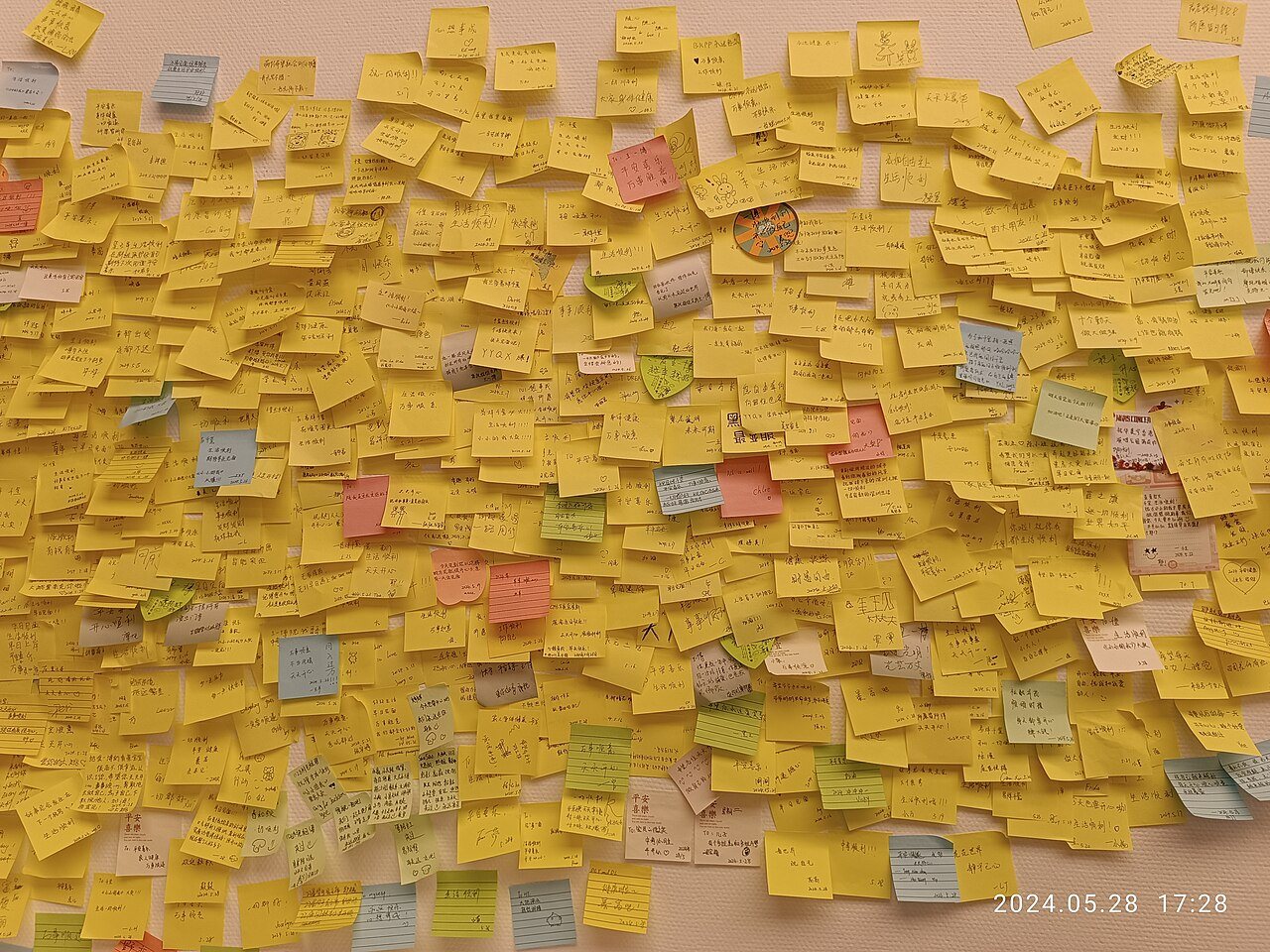
Photo: TANNMY NAISZE Wanguo, CC0, via Wikimedia Commons
There is a small pad of yellow squares on my desk that I use maybe 20 times a day, and until recently I'd never thought about the glue on the back of them. It turns out to be one of the better accidents in the history of the office. The adhesive on a Post-it Note was, by the normal standards of glue, a failure.
It also turns out I'd been peeling them wrong for years. So this one is half history and half hack, and the hack comes straight out of how the glue works.
A glue that wouldn't hold on properly
In 1968 Spencer Silver, a chemist at 3M in Minnesota, was working on adhesives and ended up with something odd. Instead of forming a smooth, strong film, his new material formed tiny spheres. It stuck to things, but not very hard, and it could be pulled off and stuck down again.
Nobody at 3M could think what to do with it. Silver spent years presenting it around the company and trying to find a use. For a while the best idea anyone had was a bulletin board coated with the stuff, so you could stick paper to the board instead of the other way round.
The hymn book bookmark
The breakthrough came from Art Fry, a product engineer at 3M who sang in his church choir. His paper bookmarks kept falling out of his hymnal. In 1974 he thought of Silver's adhesive and tried putting it on the bookmarks themselves. They stayed put, and they came out without tearing the pages.
Fry then noticed something better. He stuck one of his bookmarks on a report with a note written on it, and the note was the useful part. A piece of paper that could carry a message, stay where you put it and come off cleanly was a new kind of thing.
Even then it was not an instant hit. 3M tested the product in a few cities in 1977 under the name Press 'n Peel, and sales were poor. People didn't understand what it was for until they'd tried it. So in 1978 the company handed out free samples in Boise, Idaho, and a very large share of the people who tried them came back for more. The notes went on sale across the US in 1980 as Post-it Notes.
Why the notes are yellow
The famous colour was another accident, according to 3M's own account. The lab next door happened to have scrap paper in canary yellow, and that's what the team used for early samples. It stuck (sorry).
How the adhesive actually works
This is the part that explains the hack. Silver's adhesive is made of tiny spheres, and they don't flatten out completely when you press the note down. Only part of each sphere touches the surface. That gives enough grip to hold up a sheet of paper, but not so much that the note can't let go.
Because the spheres keep their shape, the note can be lifted and stuck down several times. Each time, though, it picks up a bit of dust, fluff and skin oil, and the contact gets weaker. That's why a note that has been moved around a lot eventually drops off the fridge.
The sideways peel that stops the curl
Most of us pull a note off the pad from the bottom edge, upward toward the sticky strip. That bends the paper sharply at the strip, and it ends up curled, so the bottom of the note sticks out from the wall or screen.
Instead, take hold of the note at one side and peel it off sideways, across the pad, along the line of the sticky strip. The paper doesn't fold back over the adhesive, so it comes away flat and stays flat. I was sceptical, and then I tried it on a full pad and haven't gone back.
It also helps to run a fingertip along the whole sticky strip when you put the note down, not just press the middle. Smooth, clean, dry surfaces work best, because textured walls, dusty shelves and anything damp give the spheres less to grab. And if a note has gone limp, pressing harder won't bring it back. It has simply collected too much fluff, and a fresh one is the answer.
Other jobs for a sticky note
Because the glue grabs lightly and lets go cleanly, sticky notes are handy for more than reminders. Run the sticky edge between the keys of a keyboard to pick up crumbs and dust. Fold one into a little shelf and stick it to the wall just under where you're about to drill a small hole, and it will catch a lot of the dust.
A safety note on that last one: always check for hidden cables and pipes before drilling into a wall, wear eye protection, and don't rely on a paper note near anything hot. And I'd be careful with fresh paint, since a note left on a wall that hasn't fully cured could leave a mark.
Spencer Silver died in 2021, more than 50 years after he mixed the glue nobody wanted. If you take one thing away from his story, make it the sideways peel. Your monitor will look a lot tidier.
See more of us on GoogleAdd Hacks Detective as a preferred source and our stories can show up more often for you in Top Stories.